I had a student the other day who said ‘let me tell you about the coelacanth’. I was happy to be able to say ‘let’s tell each other about the coelacanth’. These fish have always fascinated me so it was an amazing lesson.
The coelacanth is a pre-historic fish which lived with the dinosaurs and was thought to have been extinct for almost 100 million years, until one was found in a fishing boat catch in the South African port of East London in 1938. Because this fish has four legs it is thought by many to be the missing link between sea and land. The coelacanth is what is known as a Lazarus Taxon, which is when a species thought to be extinct is rediscovered.


The fish that was discovered in 1938 was in the catch of a trawler, the Nerine, and spotted by museum curator Marjorie Courtenay-Latimer, who realised it was something special.


I come from a small town in South Africa called Grahamstown (nowMakhanda). It is the home of the former J.L.B. Institute of Ichthyology (now The South African Institute of Aquatic Biodiversity – SAIAB), which houses several specimens of the Coelacanth. JLB Smith is the ichthyologist who recognised, identified, and named the genus Coelacanth Latimeria (Latimeria after Marjorie Courtenay-Latimer who found it)

SAIAB has a small museum containing several coelacanth and the story of its discovery.


There is also one in the Natural History Museum in London. The sign next to it points out that the coelacanth has four ‘legs’ and thus forms part of the evolutionary chain that led to land-dwelling animals. The coelacanth has four fins, or lobes, sticking out of its body like legs. Even more fascinating, it moves those fins in an alternating fashion that resembles walking or trotting. Coelacanth are also pregnant for up to three years, and give birth to live young.
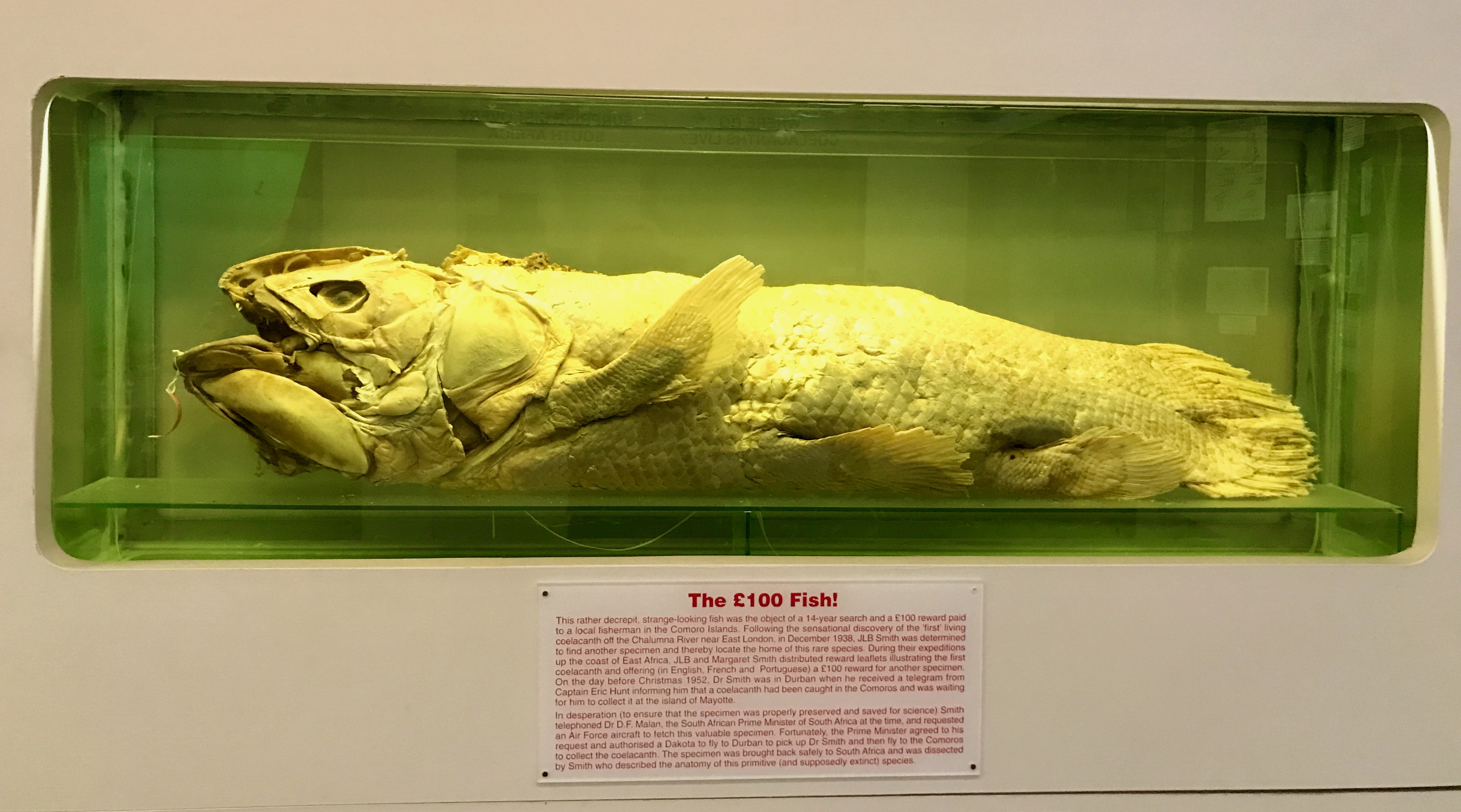


More of these fish have been discovered in various parts of the world. They live in deep waters and are not edible (well, not unless you want to get sick), but they are still critically endangered. Conservative estimates put the remaining population at about 500.
When living, these fish are bright blue and iridescent, as can be seen from these magnificent photographs, taken by Mike Frazer


And here are two videos, sourced at start, where you can see how this magnificent creatures move.
