


When Janet asked nicely if I would write something about my pen collection, there really wasn’t a competitor for the first post. The Parker ’51’ has been voted ‘best fountain pen ever’ in various polls over the years, and it is widely agreed that it is an iconic design.
The funny thing is, when I started collecting fountain pens, I just wasn’t a fan of Parker pens in general – and the ’51’ left me cold. So it came as a surprise that having acquired my first one to see what all the fuss was about, I then got another… and another… and suddenly woke up one day owning 6 of them. I always have at least one ’51’ inked up and ready to write – a good ’51’ is a solid, reliable pen with a smoooooooth nib and a large ink capacity, and a pleasure to write with.
From left to right:
’51’ Vacumatic Blue Diamond in Blue Cedar. This was my first ’51’, and was my daily writer in constant use a few years ago, until one day I forgot to take it out of my jeans pocket – and it went through the washing machine on a 40 degree cycle with some Persil. It survived almost unscathed, although I had to re-seal the hood after the shellac holding it in place came unglued in the wash. Its little blue diamond, on the top of the clip, is sadly no longer blue, though! (The blue diamond was used to indicate models which came with a “lifetime warranty” until such things were ruled illegal by the US Government. Spoilsports!)
’51’ Flighter pen and pencil set – all stainless steel, this model introduced the newfangled “Aerometric” filling system in 1948. Because of the thin metal barrel, undented Flighters aren’t terribly numerous and good ones can command a price of several hundred pounds.
’51’ Aerometric, pen and pencil set in Midnight Blue. This pair are always in my Filofax and probably get used more than any others in my collection. Sometimes that comes with dangers – I dropped this pen on its nose several years ago, and it had to take an unscheduled trip to Oxford to be sorted out by a nice man called John Sorowka who specialises in fixing, adjusting and modifying fountain pen nibs. He’s very good at it, too – when it came back I couldn’t tell the difference between how it was before its accident and after the fix.
’51’ Aerometric in Burgundy; this one has the tip of its hood broken off, but is otherwise fine – and has an unusual Oblique Medium nib.
’51’ Aerometric in Teal Blue with another unusual nib – a Fine Italic.
’51’ Demi Vacumatic in India Black fitted with a very smooth Extra Fine point. This was a smaller pocket-sized version of the pen, but its insides are the same as the larger version. Back in those unenlightened days, manufacturers often produced special versions of a pen for the ladies. This one doesn’t see that much use because it’s so fine that it tends to make my handwriting look like fluent spider. 🙂
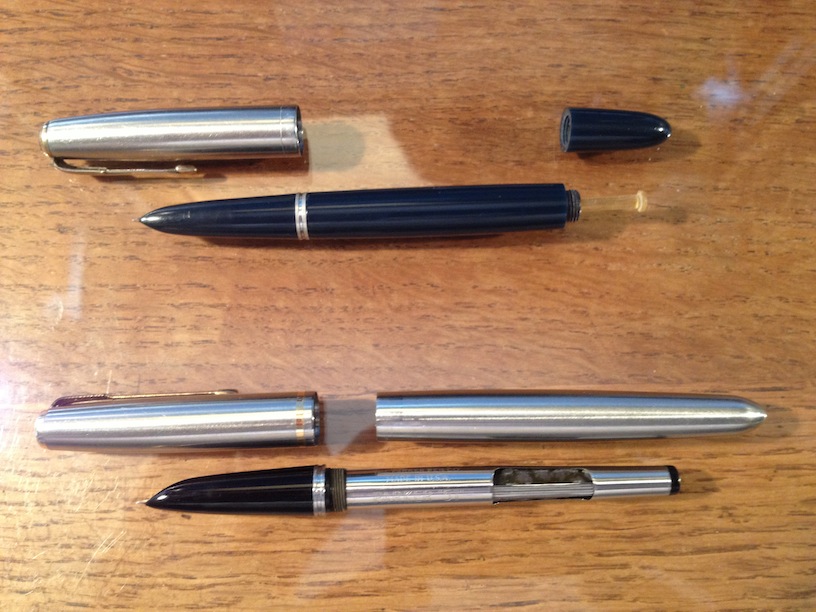
The difference between the Vacumatic and Aerometric pens is in the filling system. Vacumatics (top pen in the picture) have a “blind cap” on the rear end which covers a little push rod. Stick the nose of the pen in the ink, then push the rod 10 or 12 times to work a mechanism inside which acts like a little pump. With aerometrics, on the other hand, the whole barrel unscrews to reveal a plastic sac with a metal guard over it, and a press bar. With the nose of the pen in the ink, press the bar 4 or 6 times to fill the sac with ink. Of the two, the Aero is simpler and more reliable and recommended for first-timers.
There are also a couple of ringers in the collection:
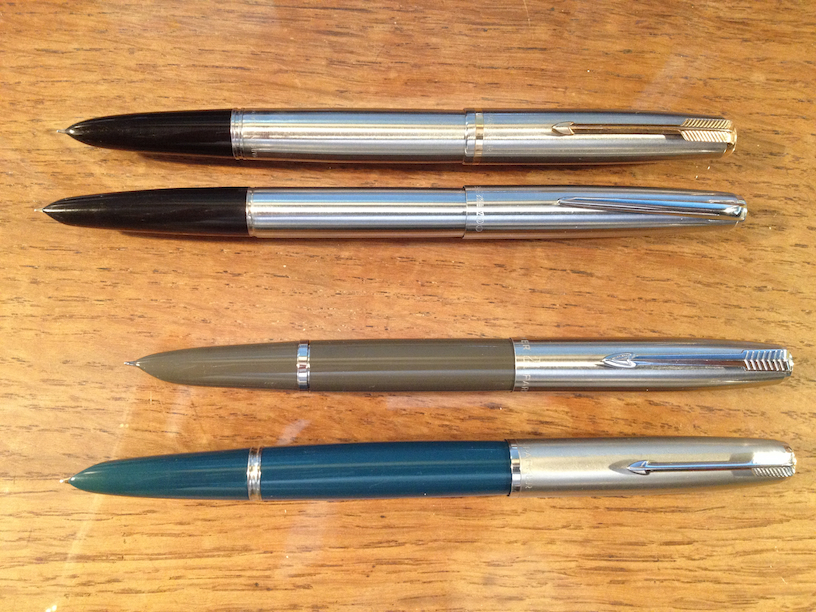
a ’21’ Super in Grey: this pen was a kind of marketing exercise by Parker. The business end is the same as a low end ’51’, and it writes just as nicely – but it was marketed at an even lower price as the top end version of the much cheaper ’21’ series. Shown here with the teal blue ’51’ for comparison;
and a Hero 100 in stainless steel: the Shanghai Hero Pen Company, um, ‘acquired’ the factory and assets of Parker in China many years ago, and have been making ’51’ derivative designs in a huge number of styles and price points ever since. Fountain pens are huge business in China (and Japan, for that matter) because the very fine strokes which make up Chinese and Japanese characters need a very fine point to write them accurately. This one is a modern version of the ’51’ flighter, complete with a gold nib – shown here next to the genuine article. It’s a nice pen, but somehow not quite as nice as the original!
Several of these came from my favourite pen dealer, Andy Evans from Andy’s Pens – no affiliation, by the way, I’m just a very happy repeat customer. He regularly has fully serviced used ’51’s available on his vintage pens page, for around £70-£100 depending on condition and rarity of the particular model or colour. One came from eBay, although I wouldn’t recommend buying a pen off eBay unless you know what to look for – it’s a minefield out there! Others are from the US, where many ’51’s were made – most of them bought through the Classified Ads pages on the Fountain Pen Network website (www.fountainpennetwork.com). FPN, as it’s known, is a slippery slope for people who like pens, and can lead to serious expenditure over time…
Finally, a bit of history, for those who are interested. The ’51’ was introduced in 1941, by the Parker Pen Company. At the time it was a radical design, made in radical materials – so radical that it was marketed at one point as “the pen that’s ten years ahead of its time!” The main aim of its design was to “write dry with wet ink” – that is, to have the writing dry on the page as fast as possible to avoid smudging and do away with the need for blotting paper.
To achieve this, Parker formulated a special ink, which was super-quick drying. It was great stuff – and only had two major problems! Firstly, in traditional fountain pens it would rapidly dry in the nib and feed, clogging the pen; and secondly, in order to make it dry so quickly it had a high solvent content – which meant that it was quite corrosive and would literally dissolve some pen materials from the inside. It literally could not be used in ordinary fountain pens of the time.
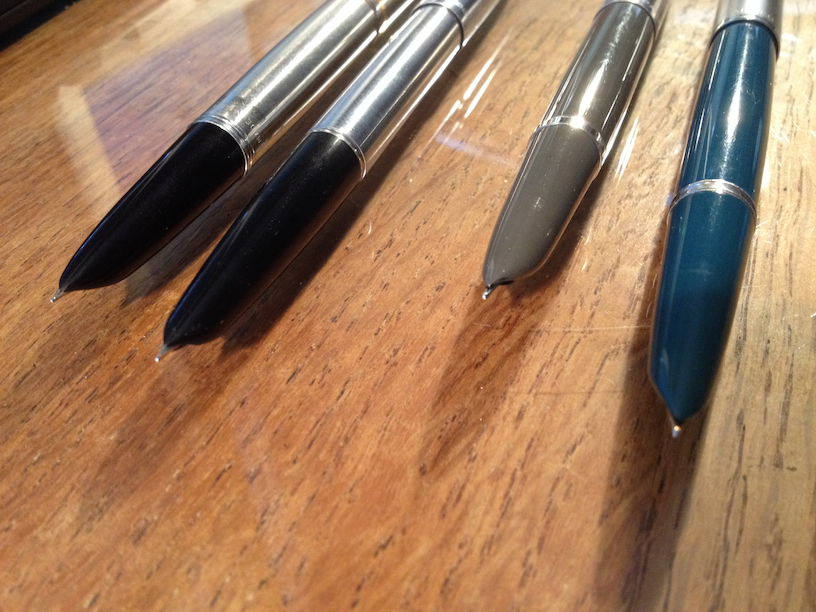
The ’51’ pen was designed to work with this difficult, corrosive ink. It was made from lucite, at that time a very new material, which wasn’t susceptible to the corrosive effects. And the problem of drying in the pen was solved by making the nib very small (and tubular), then enclosing most of it – leaving just the very point exposed to the air. There was also a huge internal capillary buffering device – called the “collector” – to replace a normal ink feed, so that there was always liquid ink available close to the nib to keep the point wet. Even the cap was designed to seal very tightly, preventing evaporation from the nib. The resulting streamlined, snub nosed look was called the “hooded nib”, and worked so well that it started a fashion for hooded nib designs. Over the production lifetime of the ’51’, Parker sold an estimated 20+ million of them (apparently they stopped counting after 12 million…). And they were so well put together that even today there are a huge number of them out there in working order, many still in use – even HM Queen Elizabeth II uses one.
For more information on the history and design of the ’51’, a good resource is Richard Binder’s website. There’s a profile of the ’51’ here , and a great “Anatomy of a ’51′” page here which has a nice cutaway diagram showing the inner workings.